In brief. AI is quickly becoming the first voice many people hear from a government service, a bank or a hospital. In the Gulf, much of that AI still thinks in English and translates into Arabic. The result is answers that are technically correct and culturally wrong: the wrong register, the wrong tone, the wrong meaning. Arabic should not be a feature added at the end of an AI project. It should be the starting point.
Imagine a customer writing to a bank’s assistant in Gulf dialect, mixing a few English words, as many people do. The assistant replies in stiff, translated formal Arabic, misreads one phrase and answers a different question. Nothing has technically failed. But the customer has learned something: this system was not built for them.
Language is not a layer on top of a service. It carries respect, formality, warmth and meaning. When an institution speaks to people in a language that feels borrowed, it loses something that is hard to measure and easy to lose: trust.
Why is translated AI not enough?
Arabic is not one register. It is formal Modern Standard Arabic in a ministerial letter, Gulf dialect in a voice message, and a mix of Arabic and English in a single sentence from a young professional. It is written right to left, often without diacritics, with names, places and religious and cultural references that carry precise meaning.
A model that learned mostly from English text and handles Arabic through translation tends to stumble exactly where it matters most:
- Dialect. It understands the formal language of documents, but not how people actually speak and write.
- Register. It cannot tell when a reply should be formal and when it should be warm.
- Mixed language. It struggles with the Arabic-English blend that is normal in Gulf workplaces.
- Context. It misses cultural and religious sensitivities that a native speaker would never miss.
- Names and places. It transliterates, misspells or confuses local names.
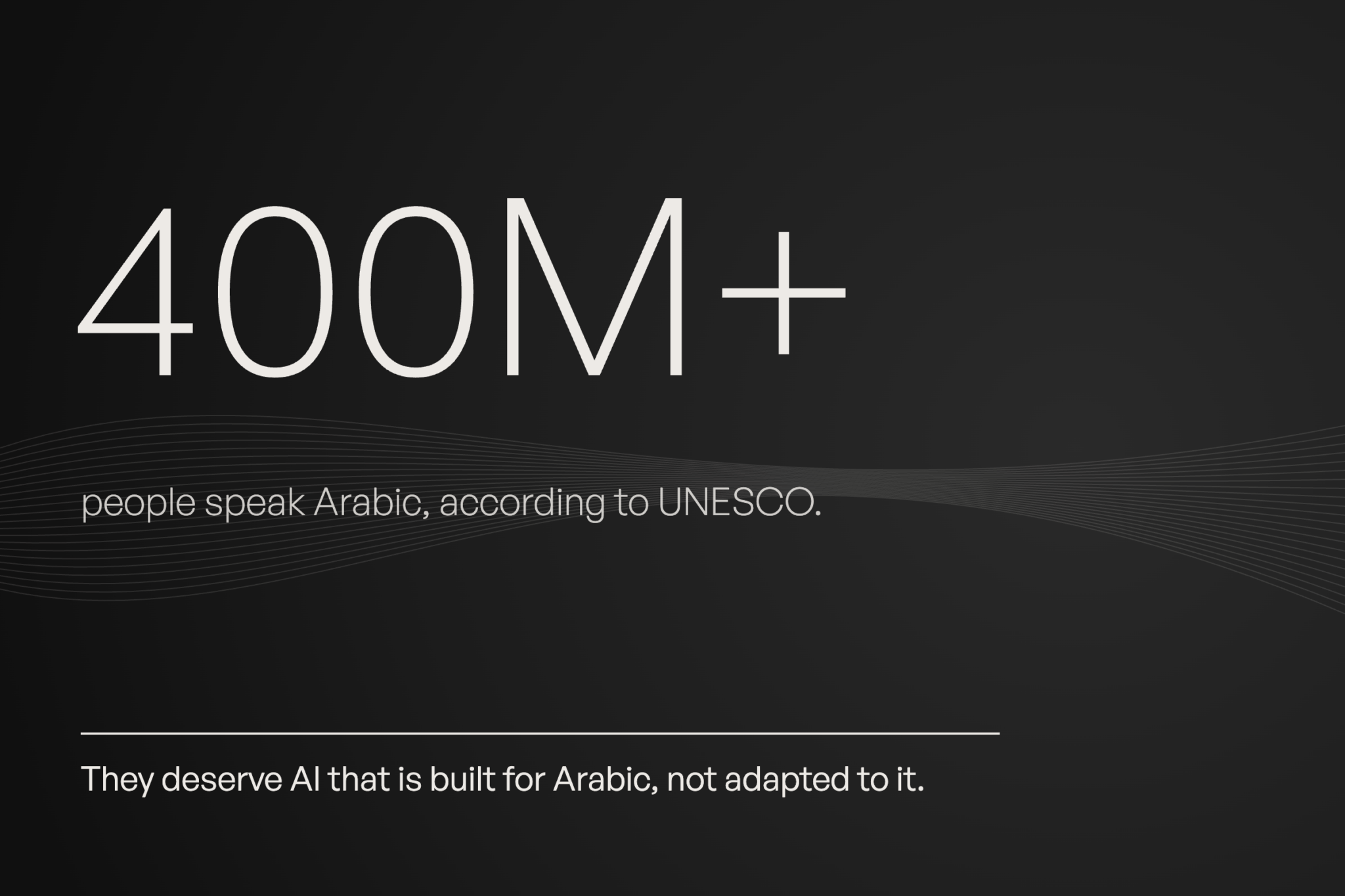
Arabic is spoken by more than 400 million people, according to UNESCO. It deserves AI that is built for it, not adapted to it.
What is already happening in the region?
The good news is that the Gulf has started to build. Arabic-focused language models such as Jais, developed in the UAE, ALLaM, developed by the Saudi Data and AI Authority, and Fanar, developed in Qatar, show that the region sees Arabic capability as a strategic asset, not a translation problem.
Arabic speakers
More than 400 million people speak Arabic, according to UNESCO.
Developed in the UAE
An Arabic-focused language model.
Saudi Data and AI Authority
An Arabic-focused language model.
Developed in Qatar
An Arabic-focused language model.
For most organisations, the question is not whether to build a model of their own. It is whether the AI they deploy, from whichever provider, truly works in Arabic for their people, their dialects and their context. That is a question of design, testing and governance, and it sits with the organisation, not the vendor.
Arabic should not be a feature added at the end of an AI project. It should be the starting point.
What does Arabic-first mean in practice?
Arabic-first is a set of choices made at the start of a project, not a language pack installed at the end.
Build evaluation sets from real Arabic queries, in the dialects your users actually speak, before you judge any model.
Policies, answers and service content should exist in Arabic as originals, not as translations of English.
Many people would rather speak than type. Recognising Gulf dialects by voice is a requirement, not a bonus.
Define what the system must never say, and how it handles sensitive topics, in Arabic.
Native-speaking reviewers should check answers regularly, not only at launch.
Be clear about where Arabic conversations are processed and stored, and under which rules.

Is this only a technology question?
No. It is a question of equal service. If a citizen gets a better answer in English than in Arabic, the institution has created two classes of service without meaning to. In public services especially, Arabic quality should be measured with the same seriousness as uptime or response time.
It is also a question of identity. Language is how a society recognises itself. The organisations that speak to people naturally, in their own language and their own way, will earn a kind of trust that efficiency alone cannot buy.
What should leaders ask before they deploy?
- Was this system tested on our users’ real Arabic, including dialects and mixed language?
- Is the quality of an Arabic answer equal to the quality of an English one?
- Who reviews Arabic answers, and how often?
- How does it handle sensitive cultural and religious topics?
- Where is our users’ data processed and stored?
Where does this leave Gulf organisations?
AI will soon be the most frequent conversation between institutions and the people they serve. In the Gulf, that conversation should sound like the Gulf. When we built Amal, DBU’s AI partner, we designed her to speak Arabic and English, by voice or chat, because we believe the people we work with should never have to switch language to be understood.
At DBU, our Technology practice helps organisations design and govern AI that works in Arabic from the first day. If you are planning an AI service for your customers or citizens, a conversation with a DBU partner is a good place to start.